Understanding Hertzsprung-Russell (H-R) Diagrams and Stellar Evolution: IGCSE Physics Guide
Last Updated: October 2026 | By EdFlik Education Team
For high school students completing the Cambridge IGCSE Physics (0625) or Pearson Edexcel IGCSE Physics (4PH1) specifications, Space Physics (Topic 6 / Topic 8) represents one of the most visually engaging yet conceptually rich modules on the exam.
Among space physics topics, questions on the Hertzsprung-Russell (H-R) Diagram and the Life Cycle of Stars (Stellar Evolution) regularly appear on Paper 2 (Multiple Choice) and Paper 4 / Paper 1 (Extended Theory). Students frequently lose marks not because they forget the names of star phases, but due to procedural errors: misinterpreting the inverted temperature axis on the H-R diagram, confusing the evolution pathways of low-mass versus high-mass stars, or failing to link gravitational collapse with radiation pressure.
In this comprehensive, exam-focused masterclass guide, our expert IGCSE physics educators break down the layout of the H-R diagram, trace step-by-step stellar evolution pathways, reveal common examiner traps, and supply a 100% copy-paste JSON-LD schema markup for your blog publishing.
Part 1: Deconstructing the Hertzsprung-Russell (H-R) Diagram
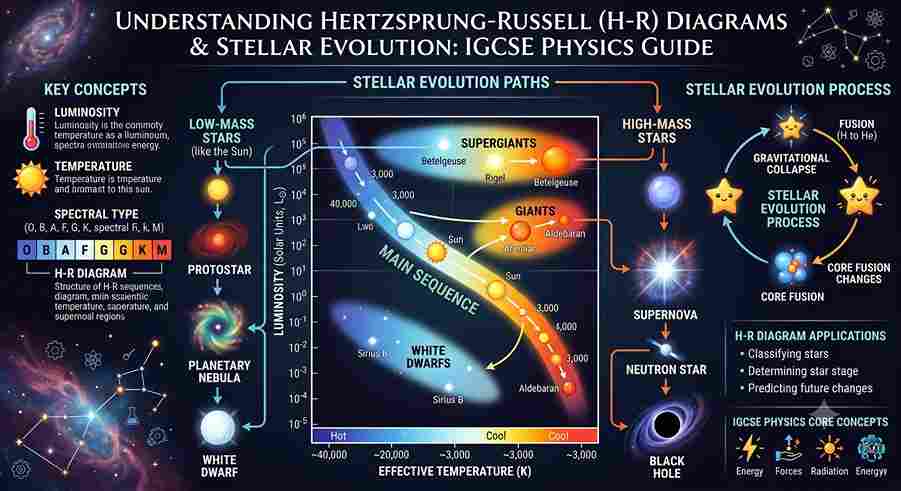
The Hertzsprung-Russell (H-R) diagram is a scatter plot that classifies stars by plotting their Luminosity (or Absolute Magnitude) against their Surface Temperature (or Spectral Class/Color).
                      AXES OF THE H-R DIAGRAM
                                 |
        +------------------------+------------------------+
        |                                                 |
Y-AXIS: LUMINOSITY / ABSOLUTE MAGNITUDE          X-AXIS: SURFACE TEMPERATURE (INVERTED!)
• Measures total energy output per second.       • Measured in Kelvin (K).
• Increases vertically from bottom to top.       • **INVERTED AXIS:** Runs high to low!
• Often scaled relative to the Sun ($L/L_\odot$). • Hot blue stars on the LEFT ($\sim 30,000 \text{ K}$).
                                                 • Cool red stars on the RIGHT ($\sim 3,000 \text{ K}$).
The 4 Major Star Regions on the H-R Diagram
Examiners will frequently present a blank or partially labeled H-R diagram and ask you to identify four distinct stellar populations:
  Luminosity
    (High)  ^       [SUPERGIANTS]
            |
            |                 [MAIN SEQUENCE]
            |      [GIANTS]        /
            |                     /
            |                    /
            |      [WHITE DWARFS]
    (Low)   +------------------------------------->
           30,000 K (Hot/Blue)          3,000 K (Cool/Red)
                          Surface Temperature
- Main Sequence: A diagonal band running from the top-left (hot, bright, high-mass stars) down to the bottom-right (cool, dim, low-mass stars). About $90\%$ of all stars in the universe, including our Sun, are Main Sequence stars fusing hydrogen in their cores.
- Red Giants: Located in the top-right quadrant. These stars have cool surface temperatures (red) but very high luminosity due to their massive surface areas.
- Red Supergiants: Located at the extreme top-right. Enormous, highly luminous stars formed from high-mass main sequence stars.
- White Dwarfs: Located in the bottom-left quadrant. These are hot (white/blue) dead stellar cores with low total luminosity because of their small physical surface area (planet-sized).
Part 2: Stellar Equilibrium — The Tug of War Inside a Star
A star remains stable on the Main Sequence for millions or billions of years because it is in hydrostatic equilibrium (a balance of forces):
$$\text{Gravitational Attraction (Inward)} = \text{Radiation \& Thermal Pressure (Outward)}$$
                   HYDROSTATIC EQUILIBRIUM IN MAIN SEQUENCE
                                      |
        +-----------------------------+-----------------------------+
        |                                                           |
INWARD FORCE: GRAVITATIONAL COLLAPSE                         OUTWARD FORCE: RADIATION PRESSURE
• Pulled inward by the total mass of the                     • Created by nuclear fusion of hydrogen into
  star attempting to collapse it.                              helium in the core releasing immense energy.
When hydrogen fuel in the core runs out, fusion slows down, radiation pressure drops, and gravity causes the core to contract, initiating the next stage of stellar evolution.
Part 3: Stellar Evolution Pathways (Low-Mass vs. High-Mass Stars)
The ultimate fate of any star depends strictly on its initial mass during formation.
                         STELLAR EVOLUTION FLOWCHART
                                      |
                             [ PROTOSTAR / NEBULA ]
                                      |
                           [ MAIN SEQUENCE STAR ]
                                      |
        +-----------------------------+-----------------------------+
        |                                                           |
LOW-MASS STAR (e.g., Sun)                                   HIGH-MASS STAR (> 8 Solar Masses)
  │                                                           │
  ▼                                                           ▼
[ RED GIANT ]                                               [ RED SUPERGIANT ]
  │                                                           │
  ▼                                                           ▼
[ PLANETARY NEBULA ]                                        [ SUPERNOVA ]
  │                                                           │
  ▼                                          +----------------+----------------+
[ WHITE DWARF ]                              │                                 │
  │                                          ▼                                 ▼
  ▼                                  [ NEUTRON STAR ]                   [ BLACK HOLE ]
[ BLACK DWARF ]
Pathway 1: Low-to-Medium Mass Stars (like our Sun)
- Stellar Nebula: A giant cloud of interstellar dust and hydrogen gas collapses under its own gravitational attraction.
- Protostar: As mass gathers, gravitational potential energy converts to thermal energy. Pressure and temperature increase until core temperature reaches $\sim 15 \text{ million K}$, triggering nuclear fusion ($4\text{H} \rightarrow \text{He}$).
- Main Sequence: Hydrogen fusion in the core creates outward radiation pressure, balancing inward gravity.
- Red Giant: Hydrogen in the core exhausts. The core collapses under gravity and heats up, allowing hydrogen fusion in a shell surrounding the core and helium fusion in the core. The outer envelope expands and cools, turning red.
- Planetary Nebula: Helium fusion ends. The outer layers of gas are ejected into space as a expanding shell.
- White Dwarf: The bare, dense core of carbon and oxygen remains. No further fusion occurs; it gradually cools over billions of years into a cold Black Dwarf.
Pathway 2: High-Mass Stars (Greater than 8 Solar Masses)
- Protostar & Massive Main Sequence: Burns hydrogen at an astronomical rate, staying hot and blue.
- Red Supergiant: When core hydrogen depletes, the massive gravitational collapse produces temperatures high enough to fuse heavier elements (Helium, Carbon, Oxygen, Neon, Silicon) up to Iron ($^{56}\text{Fe}$).
- Supernova: Iron cannot release net energy through fusion. Core fusion abruptly stops, causing a catastrophic gravitational collapse followed by a violent explosion. Elements heavier than iron (gold, uranium) are synthesized and scattered across the galaxy.
- Remnant (Neutron Star or Black Hole):
- If core remnant mass is between $\sim 1.4$ and $3$ solar masses: collapses into an ultra-dense Neutron Star.
- If core remnant mass exceeds $\sim 3$ solar masses: collapses completely into a Black Hole, where gravitational force is so intense that not even light can escape.
Part 4: Top 4 Traps That Cost Students Marks in IGCSE Physics
- Misreading the X-Axis on the H-R Diagram: Assuming temperature increases from left to right like standard graphs. Temperature DECREASES from left to right! The hottest stars are on the left; the coolest are on the right.
- Confusing Red Giants and Red Supergiants: Stating that the Sun will explode in a supernova to form a black hole. Low-mass stars (like the Sun) end as White Dwarfs, never supernovas.
- Confusing Nuclear Fusion with Fission: Writing that stars produce energy through nuclear fission (splitting heavy nuclei). Stars generate energy exclusively through nuclear fusion (joining light nuclei).
- Forgetting Radiation Pressure in Equilibrium Answers: Writing only "heat balances gravity" when explaining why main sequence stars are stable. You must explicitly mention outward radiation/thermal pressure balancing inward gravitational collapse.
Preparing for Cambridge (0625) or Edexcel (4PH1) IGCSE Physics exams and aiming for an $8/9$ ($A^$) grade? EdFlik connects international school students globally with expert, 1-to-1 online IGCSE physics tutors, helping you master astrophysics, H-R diagrams, nuclear physics, and past-paper exam strategies. *Book a Free Demo Class Today!
Frequently Asked Questions (FAQs)
Q1: Why are White Dwarfs located in the bottom-left of the H-R diagram?
Ans: White Dwarfs have very high surface temperatures (making them hot/white, so they sit on the left), but because they are physically small (earth-sized core remnants), their total surface area is low, resulting in low overall luminosity (placing them at the bottom).
Q2: How does an H-R diagram show the life cycle of a star?
Ans: As a star evolves, its surface temperature and luminosity change, causing its position on the H-R diagram to shift. For instance, a main sequence star moves up and to the right into the Red Giant region, and later drops down to the bottom-left as a White Dwarf.
Q3: What element is the heaviest that can be produced by nuclear fusion inside a massive star core before a supernova?
Ans: Iron ($^{56}\text{Fe}$). Fusing iron consumes energy rather than releasing it, which deprives the core of thermal pressure and triggers the sudden gravitational collapse of a supernova explosion.
Q4: How does EdFlik support IGCSE Physics students?
Ans: EdFlik connects international school students worldwide with vetted, expert 1-to-1 online tutors specializing in Cambridge (0625) and Pearson Edexcel (4PH1) IGCSE Physics. Our personalized coaching focuses on simplifying space physics, optics, electricity, and structured past-paper drilling.
More on IGCSE & GCSE