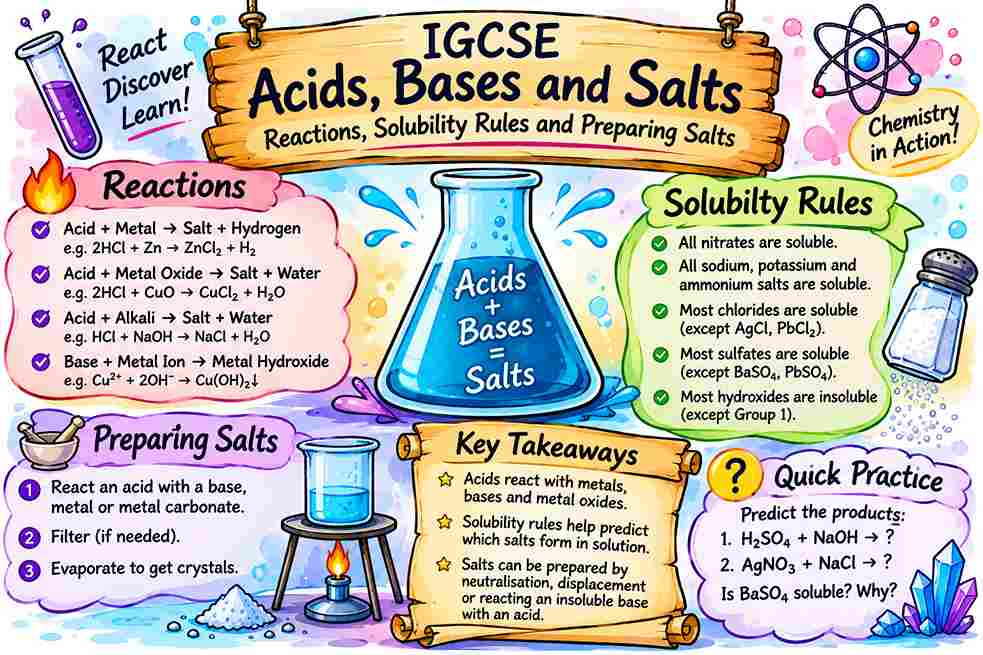
IGCSE Acids, Bases and Salts: Reactions, Solubility Rules and Preparing Salts
Last updated: November 2026 | By EdFlik Education Team
Acids, bases and salts is a large topic with predictable question types: write the equation, choose the method for making a salt, and describe the practical. This guide covers all three.
Reactions of acids
Acid reacts with |
Products |
Example |
A metal (above hydrogen in the reactivity series) |
Salt + hydrogen |
Mg + 2HCl → MgCl₂ + H₂ |
A base (metal oxide or hydroxide) |
Salt + water |
CuO + H₂SO₄ → CuSO₄ + H₂O |
An alkali |
Salt + water |
NaOH + HCl → NaCl + H₂O |
A carbonate |
Salt + water + carbon dioxide |
CaCO₃ + 2HCl → CaCl₂ + H₂O + CO₂ |
Neutralisation in ionic form:H⁺ + OH⁻ → H₂O. Salt names come from the acid: hydrochloric acid gives chlorides, sulfuric acid gives sulfates, nitric acid gives nitrates.
pH and strength
- pH below 7 is acidic, 7 is neutral, above 7 is alkaline.
- A strong acid is fully ionised in water (for example hydrochloric acid); a weak acid is only partially ionised (for example ethanoic acid).
- Strength is not the same as concentration. A dilute solution of a strong acid can have a higher pH than a concentrated solution of a weak acid.
- Universal indicator gives a colour for each pH; litmus only shows acid or alkali.
Solubility rules
Salt type |
Soluble? |
All nitrates |
Soluble |
Sodium, potassium and ammonium salts |
Soluble |
Chlorides |
Soluble, except silver and lead chlorides |
Sulfates |
Soluble, except barium and lead sulfates (calcium sulfate is slightly soluble) |
Carbonates and hydroxides |
Insoluble, except sodium, potassium and ammonium |
Choosing a method to make a salt
Salt is… |
Starting materials |
Method |
Soluble, from an insoluble base or carbonate |
Acid + excess insoluble solid |
Add excess solid, filter, crystallise |
Soluble, from an alkali |
Acid + alkali |
Titration, then crystallise |
Insoluble |
Two soluble salts |
Precipitation, filter, wash, dry |
Method 1: soluble salt from an insoluble base
Worked example: copper(II) sulfate crystals
- Warm dilute sulfuric acid in a beaker.
- Add copper(II) oxide a little at a time, stirring, until no more dissolves. The excess solid shows all the acid has reacted.
- Filter to remove the excess copper(II) oxide.
- Heat the filtrate to evaporate about half the water, until the point where crystals start to form on a glass rod dipped in and cooled.
- Leave to cool and crystallise, filter, wash briefly with cold distilled water and dry between filter papers.
Method 2: titration
Use when both reactants are soluble and neither can be added in excess. A pipette measures the alkali; a burette adds acid; an indicator shows the end-point.
- Repeat until you get results close together (concordant results) and use their mean.
- Then repeat the reaction without the indicator, using the volume found, so that the salt is not contaminated.
- Evaporate, crystallise, filter and dry.
Method 3: precipitation
Worked example: lead(II) iodide
- Mix lead(II) nitrate solution with sodium iodide solution: Pb(NO₃)₂ + 2NaI → PbI₂ + 2NaNO₃.
- Yellow lead(II) iodide is insoluble, so it precipitates.
- Filter, wash the solid with distilled water and dry.
Common mistakes
- Using too little solid, so some acid is left in the filtrate.
- Evaporating to dryness instead of to the crystallisation point.
- Not repeating the titration without indicator.
- Confusing strength with concentration.
- Choosing precipitation for a soluble salt.
Practice questions
Question |
Answer |
1. Write the ionic equation for neutralisation. |
H⁺ + OH⁻ → H₂O |
2. Which method would you use to make sodium chloride from sodium hydroxide and hydrochloric acid? |
Titration |
3. Why is excess copper(II) oxide added? |
To make sure all the acid has reacted |
4. Name the products when calcium carbonate reacts with hydrochloric acid. |
Calcium chloride, water and carbon dioxide |
Frequently asked questions
Q: How do I choose the right method to make a salt?
Check whether the salt is soluble. Insoluble salts use precipitation; soluble salts from solids use excess solid and filtration; soluble salts from alkalis use titration.
Q: What is the difference between strong and concentrated?
Strong describes how fully an acid ionises; concentrated describes how much acid is dissolved.
Q: Why wash the crystals?
To remove soluble impurities, using a small amount of cold distilled water so the crystals do not dissolve.
Q: Do I need to memorise the solubility rules?
Yes. Questions on salt preparation depend on them.
Try a free trial class with EdFlik. Live 1:1 IGCSE tutoring for Cambridge and Edexcel students in the UAE, matched to your child's board, subject and year group. Book at edflik.com or message us on WhatsApp. |
Related reading
- IGCSE Chemistry Electrolysis
- IGCSE Chemistry Mole Calculations
- IGCSE Chemistry (0620 / 4CH1) Guide
Sources
- Cambridge International IGCSE Chemistry 0620 syllabus 2026–2028
- Pearson Edexcel International GCSE Chemistry 4CH1 specification
More on IGCSE & GCSE
- IGCSE in the UAE: A Complete Guide to Boards, Subjects, Exams and Revision
- IGCSE Biology Tutor Online: Preparing for the Exam Papers
- IGCSE Maths Trigonometry: From SOH CAH TOA to the Sine and Cosine Rules
- Preparing for IGCSE Options: How Year 9 Students in the UAE Should Choose Their Subjects
- All IGCSE & GCSE articles