IGCSE Standard Form: Writing, Calculating and Using Your Calculator
Last updated: November 2026 | By EdFlik Education Team
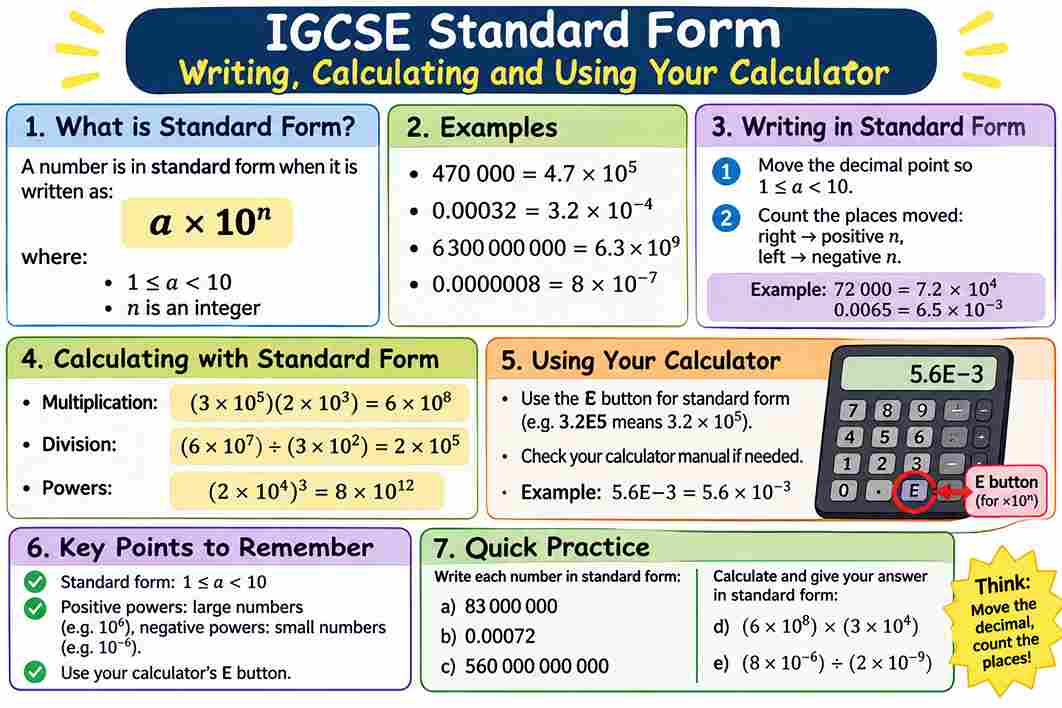
Standard form writes very large or very small numbers as a × 10ⁿ, where a is at least 1 and less than 10 and n is an integer. It is tested in number questions and in science. This guide covers every skill the exam asks for.
Writing numbers in standard form
Number |
Standard form |
How |
450 000 |
4.5 × 10⁵ |
Move the decimal point 5 places left |
0.00032 |
3.2 × 10⁻⁴ |
Move the decimal point 4 places right; the power is negative |
72 000 000 |
7.2 × 10⁷ |
7 places left |
0.0007 |
7 × 10⁻⁴ |
4 places right |
Large numbers have a positive power; numbers smaller than 1 have a negative power.
Multiplying and dividing
Multiply or divide the front numbers, and use the index laws on the powers of 10.
Worked example 1: multiply
Calculate (3 × 10⁴) × (2 × 10⁵).
- 3 × 2 = 6 and 10⁴ × 10⁵ = 10⁹.
- Answer:6 × 10⁹.
Worked example 2: multiply with a front number above 10
Calculate (4 × 10⁵) × (5 × 10³).
- 4 × 5 = 20 and 10⁵ × 10³ = 10⁸, giving 20 × 10⁸.
- 20 is not between 1 and 10, so write2 × 10⁹.
Worked example 3: divide
Calculate (6 × 10⁸) ÷ (2 × 10³).
- 6 ÷ 2 = 3 and 10⁸ ÷ 10³ = 10⁵.
- Answer:3 × 10⁵.
Adding and subtracting
Convert both numbers to the same power of 10 first.
Worked example 4
Calculate 3.2 × 10⁴ + 5 × 10³.
- Write 5 × 10³ as 0.5 × 10⁴.
- 3.2 × 10⁴ + 0.5 × 10⁴ =3.7 × 10⁴.
A real-world example
Light travels at about 3 × 10⁸ m/s. How far does it travel in one hour (3600 s)?
- 3 × 10⁸ × 3600 = 3 × 10⁸ × 3.6 × 10³ = 10.8 × 10¹¹.
- In standard form:1.08 × 10¹² m.
Using your calculator
- Use the ×10ˣ or EXP key, not typing × 10 ^ separately, to avoid bracket errors.
- Check the display format: some calculators show 3E8, which must be written as 3 × 10⁸ in your answer.
- Do not round until the final step.
Common mistakes
- Leaving the front number outside the range 1 ≤ a < 10, for example 20 × 10⁸.
- Using a positive power for a number smaller than 1.
- Adding the powers when adding the numbers.
- Copying the calculator display "E" into the answer.
Practice questions
Question |
Answer |
1. Write 0.0007 in standard form. |
7 × 10⁻⁴ |
2. Calculate (5.2 × 10³) × (3 × 10²). |
1.56 × 10⁶ |
3. Calculate (8 × 10⁶) ÷ (4 × 10²). |
2 × 10⁴ |
4. Write 6.5 × 10⁵ as an ordinary number. |
650 000 |
Frequently asked questions
Q: What is standard form?
A way of writing numbers as a × 10ⁿ with 1 ≤ a < 10 and n an integer.
Q: How do I know whether the power is positive or negative?
Numbers 10 or bigger have a positive power; numbers between 0 and 1 have a negative power.
Q: How do I add numbers in standard form?
Write them with the same power of 10, add the front numbers, then check the result is still in standard form.
Q: Do I need to show working?
Yes, especially when the front number needs adjusting.
Try a free trial class with EdFlik. Live 1:1 IGCSE tutoring for Cambridge and Edexcel students in the UAE, matched to your child's board, subject and year group. Book at edflik.com or message us on WhatsApp. |
Related reading
- IGCSE Indices and Surds: Rules and Worked Examples
- IGCSE Percentages: Compound Interest and Reverse
- IGCSE Physics Equations: Rearranging and Units
Sources
- Cambridge International IGCSE Mathematics 0580 syllabus (number content)
- Pearson Edexcel International GCSE Mathematics A 4MA1 specification
More on IGCSE & GCSE
- IGCSE in the UAE: A Complete Guide to Boards, Subjects, Exams and Revision
- How to Improve IGCSE English First Language Essay Writing
- IGCSE Narrative Writing UAE 2026 — How to Write an A* Story for Cambridge 0500
- IGCSE Chemistry Electrolysis: Predicting Products and Writing Half-Equations
- All IGCSE & GCSE articles